

Wind, sand and camels.
The big national road N1 takes us along the Atlantic coast into Western Sahara. The wind is incredibly strong - not just strong - but strong enough to push one into the ditch when absentminded for a little while in the saddle. Fortunately indeed, it hits us as a hind wind now. With speeds up to 30km per hour we whizz through the desert!
Every couple of kilometers there is a sign asking to pay attention to camels crossing the road. At first I expect them to be as useless as I remember the warnings from my first bicycle trip through Finland back in 1994: bright yellow moose signs everywhere but not a single moose to be found!
Not so here in the desert - there are camels all over the place. Most of them free range, just strolling about in small herds, eating the thorny bushes on the roadside. No herdsmen to be seen. Every once in a while we stumble upon an unlucky one; either welcoming us with a biting stench of decomposing flesh or in its final stage...
Time to smirk about the name of my bicycle water bottle - it's a "CAMELBAK"


The Western Sahara Region (kind of annexed by Morocco, supervised by the United Nations) begins right after the town of Tarfaya, famed for the writer St.Exupery who was stationned here as a pilot for the French army. It is said that the Tarfaya and its environment inspired him while writing the story of the little prince... The town is a friendly little fishing village with little to offer except peace and quiet. And fresh fish - battered and with a side of French Fries.

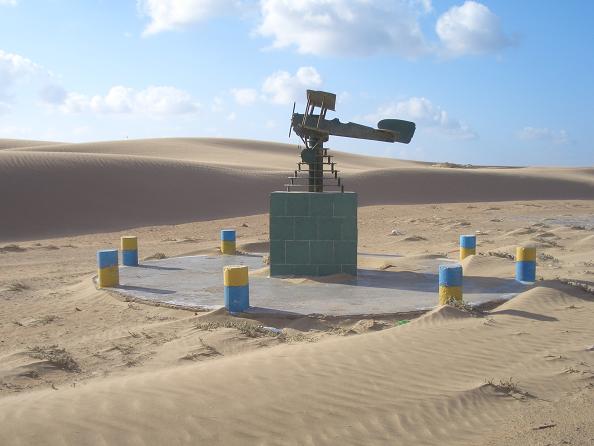
We keep on going south - happy go lucky with the constant hind wind. The coast line is very empty and beautiful. Kind of ideal for a beach holiday if one has a square kilometer of shade and a big fridge in the luggage. We keep waking up early in the mornings to make use of the colder times (BTW in the night we are wearing fleece jackets) and then try to take a rest in some shade during the hottest hours of the day. The thermometer doesn't goes beyond 40 Centigrade but the sunlight is very strong. In the late afternoon we resume cycling until an hour before sunset. We usually pitch up the tent wherever we find a nice spot. We never felt threatened or had any bad experience with wild camping here in Morocco. Very very pleasant.
Sometime somewhere I reach the 20.000km mark... technically I am half around the world already :)


20 May 2010
Camels ahead - Western Sahara
4 May 2010
From Atlas via Anti-Atlas to Western Sahara

It is hard to describe what this great country does to us...
We first cycle from Tangiers south along the Altantic coast and then head inland toward the ancient city of Meknes. We mostly camp wild just wherever we think we should stop for the night; and receive - if any - only pleasant surprises. One night a truck driver stops and comes running over to our tent inquiring if everything is alright, another night the owner of the field of olives trees (Ahmat) in which we pitched up the tent for the night visits us and wants to know if we need bread, milk or water. Later, when a sudden downpour drenches the tent thorroughly, Ahmat shows up again with his son to help us bring the tent and our belongings to his house so we won't have to stay out on our own. We politely decline his offer but wonder how he must have felt later on when the rain turned into a full blown hail storm with hail the size of pop corn (no joke).
From Meknes (very worth a visit) we take public transport to the capital Rabat (with a side trip to Casablanca) to apply for the Mauretanian visa. In earlier times the visa could be obtained directly at the border betzeen Western Sahara and Mauretania. But since a couple of months one needs to pass by the embassy in Rabat. When applying around 0900 hours in the morning one can pick up the visa in the early afternoon of the same day.
With the visa in our pockets we made it back to Meknes and then had a wonderful day riding aith hindwind to Fes. Fes does indeed have a nice casbah, but the city itself is only recommendable for those who love placing themselves in the midst of hordes of caravan campers or enjoy an afternoon full of tout-hassling and being-ripped-off-at-every-corner. The city reeks of what tourism can detroy in a perfectly modest and friendly population.
We just long enough to eat and sleep and leave early the next morning direction Sefrou and the Atlas mountains.


The Atlas treats us with lots of hills, beautiful landscapes, sleepy towns and local food. Susan has discovered a new favorite: greasy bread. It is kind of like filo dough on a cast iron stovetop bathed in butter. Yum.
Another great discovery after a sobering experience in Spain and Portugal (those barbarian tribes have seemingly not yet discovered the secret of fresh milk!) is that Morocco is full to the brim with milk and dairy products. We devour yoghurts and other goodies day in day out. The top product to discover here: avocado milk!
When we don't lay in the shade of some date tree rubbing our dairy filled ballies, we cycle through olive gardens, strawberry fields and orange orchards. The road takes us up up up beyond the tree line all the way to 1907m in the High-Atlas, then back down into the Draa valley and the fringes of the Sahara desert. The temperatures rise every day and soon we decide to get up around 0400 hours very early in the morning so we can be on the road at first daylight to avoid the midday heat. We cycle until around 1100 and then rest in the shade of some roadside trees or - if we hit it lucky - in a small restaurant or truck stop. When the sun starts going down around 1600 we hit the road again and cycle until nightfall.
Against all advise that we had received earlier, the Moroccan traffic is very good to cyclists. It might seem chaotic at first but we soon recognise that most vehile drivers behave with lots of respect and don't force their way. There is a lot of honking but this happens not in order to intimidate (like it would in Germany) but simply to inform about one's presence. Often a couple of quick extra honks are thown in together with a thumbs-up and great smiles. Especially the truck drivers seem to enjoy our presence - thanks be to all of them!
The roads that link bigger cities are often well paved and one needs to go off the beaten track to find a good old counrt road with potholes and a dusty surface. Nevertheless, in the small town of Agdz (towards the Anti-Atlas), Susan's back rim has had it: it breaks. To our misfortune it is friday and many shops close during the prayers. To our greater misfortune the next day is the first of May and a public holiday. The only rim that I can locally find is a very simple Chinese made alloy rim that (my estimation) would last about a week's time. And besides: the spokes in Susan's rear wheel are not long enough to accommodate this rim. While we contemplate over coffee what to do I suddenly spot a fairly nice mountainbike leaning against one of the tables of the nearby restaurant. Am I suffering a heat stroke or is that really a Campagnolo sticker on that rim? I check it out and cannot believe our luck - someone here actually has a real nice rim in hisrear wheel. It's old but it will do the job. Mahammat (the owner of the mountainbike) is located rather quickly once news make it that a foreigner wants to buy his rim. He grins over both ears when we start negotiating the price: approximately 20EUR plus the local Chinese made rim.


Luck in the Unluck (Glueck im Unglueck _ German proverb)! The rim fits with Susan's spokes and Mahammat's spokes are actually sufficiently long for the Chinese model. After about 5 hours of painstakingly sweaty work everything is back together and Susan takes a test ride... hooray!!!
We now cycled several hundreds of kilometers with the new rim and have just reached the Atlantic Ocean again at Tan-Tan. The ocean is wild and beautiful and the absence of European camper vans makes everything even better. Last week we took the bus to Agadir to celebrate Susan's 36th birthday with Pizza and ice cream. Next week we will cross the border to Westarn Sahara and then head down towards Dhakla and then Mauretania. If we are lucky then the current strong wind will be in our back all the way along the coast!
Until later...
(and BTW, that's how our map looks like on a day when we suddenly find a highly loved but totally unexpected dairy product in a small roadside shop :)
18 April 2010
Morocco!


... not much to say at this moment in time except that the country and its people are treating us with utter bliss! This is an absolutely great trip so far.
We cycled from Tanger to Meknes and now visit the capital Rabat for a few days to apply for the Mauretanian visa...
Windy times - Portugal and Spain

We are back on track!
From North America we fly to Germany where we visit my parents in the beautiful Black Forest. Then we try a completely different adventure before we continue with the cycling: hitch-hiking through Europe!
I have hitched a lot when I was young and now we thought we give it a try again; will people still take you on a ride when you're 35?
The Michelin Route Planner calculates that a trip by car from the Black Forest to Porto at the west coast of the Iberian penninsula should take roughly 24 hours. If you are driving your own vehicle.
We start hitching at a gas station close to Mulhouse (thank you Gabi!!!) around 10 in the morning. And arrive in Portugal before we can believe it ourselves! Via Lyon and Montpelier, Toulouse, Bayonne and Leon we arrive in Porto even less than 24 hours later. Hitch - Hitch - Hooray! It is still doable :)


We take public transport from Porto to Leiria where the bicycles are parked. I am a little nervous because we had just left the bikes with the next person we could find in Leiria last year in November - we kind of were in a hurry to catch a flight from Lisbon to Chad back then...
Now - five months later - will the bikes still be with Fernando, the friendly motorbike mechanic?
...they are. Thank you sooooo much, Fernando. You were a great help in times of need!
Back in the bicycle seats, we head towards the hilly terrains between Portugal and Spain. The plan is to take a ferry to Morocco from the southern tip of Europe - the hippie and surfer capital Tarifa.
On the way there we pass beautiful landscapes, very hilly but full of oak and cork trees. The cork is used for wine production while fruit of the oak trees are used to feed the famous black iberian pigs that are later turned into some of the best quality Serrano ham.
After crossing into Spain the hills are getting less but then the wind picks up in Andalusia. We start to fight a fierce fight against a strong and everlasting headwind all the way until Tarifa!


But life keeps treating us good with plenty of beutiful weather, lovely sunsets and cinnamon cake - Susan's new addiction.


On the way south, we pass by many a nice town, one particularily nice one being the lovely town of Evola with its narrow alleyways and white and yellow painted houses. And then - we suddenly first smell and later see the ocean again; Tarifa!
28 March 2010
Hooray - the trip continues!!!
