
hello dear fellow humans,
let me say that this post contains good and bad news.
the bad news are that this blog ends here. for reasons i will explain below.
the good news are that if you are interested in this and future trips of ours you are herewith invited to come and meet us and we can have coffee and tea and maybe homemade cookies and talk about it. some might call that "chatting".
you can also write to me via email my address is tim(underscore)haus(at)yahoo.de
underscore is this little guy here: _
you can also (and i think this is my favorite option and will certainly be yours even though you might not know about that yet): take a bike, a tent, a sleeping mat and some food and HEAD OUT. LEAVE. RIDE AROUND THE WORLD BY YOURSELF. and maybe we will meet. and we will. there is a tribe out here. a tribe that knows no religious or racial boundaries. a tribe of people that travel and live the slow way. the way that makes no sense to most people. the way that seems exhausting, sweaty, barefoot, waste-of-time, irresponsible, foolish.
but lifestyle-fads listen up: you are right about all this. it is an exhausting, sweaty, barefoot and waste-of-time kind of life. A WONDERFULLY EXHAUSTING, SWEATY, WASTE OF TIME!!!
you might be calling it irresponsible and/or foolish. if so you are not part of the tribe. or maybe (hopefully) just never met the (your?) tribe.
BUT if you have met and recognized the tribe then you can and often will find your tribal people. they roam in many different places. they believe in many different ideas. they do many different things.
things. they DO them. they do not own them. or simply put, they share a belief: "the most important things in life are not things."
they might not understand when you speak of re-financing your house, of twittering, of coupons and the cloud. they don't know about the latest movies, the stock exchange, fashion, the annual geneva car exhibit, all-inclusive-travel offers to costa rica. they might know the weather (not from their app or the weather channel). they might know the phase of the moon. they have smelled the smoke of a campfire lately. they have actually seen a sunset and enjoyed watching it instead of trying to take a million pictures so they can upload them onto facebook. they don't but apples from new zealand when they live in europe and they don't buy apples from america when they live in new zealand.
they think twice before they buy things and twice again before they throw them out. they might drive cars but they are aware of why and when. they save energy not because it saves money. but because it might save us all some day.
note: some say i must think of myself as some kind of know-it-all. they call me arrogant. as if i knew the right answers. this is not the case.
i don't know the answers. and i don't mean to suggest (or fake) that i do.
what i do know is that i DO NOT UNDERSTAND a lot of things. like: why do people spend the majority of their llifetime in a building on wall street? why do people think it is more important to eat a lot of tasty stuff rather than eat something good? why do people think bigger is better? why are diamonds such a cherished commodity? (they are ugly artificial looking rocks for goodness' sake...) why would you enslave or kill for such a thing? what is polysorbate 80 and why do so many people eat it despite the fact that they don't understand what it is? why do people travel to the end of the world on airplanes to see paradise when they should sensibly know that this destroys the paradise? HOW CAN PEOPLE BUY COUNTLESS TOYS FOR THEIR OFFSPRING AND NOT UNDERSTAND THAT THIS OVERCONSUMPTION DIRECTLY (and in a negative way) IMPACTS ON THE QUALITY OF LIFE OF THOSE SAME CHILDREN OR GRANDCHILDREN?
many questions. i don't know answers. what i do know though is that i can and will live without shops like walmart. i know that my lettuce from the farmers market for $4 is cheaper than the lettuce for $2 at saveway. i know that convenience makes you sick, dumb, fat, complacant, ignorant to the reality of life or possibly all of those things together. i know people want more. and more. and more. until they have more than they can handle. more stuff, more house, more car, more mobility, more friends on facebook. we humans are made that way.
and now tou think: "duh, why is this know-it-all telling me this?"
because i feel like it. because it is something we should think about. because it is something we chose not to think about as soon as we have formed an opinion. because we seem to think that forming an opinion means to keep having that same opinion forever and to have to defend it no matter what. because i think it is good (not ok, but GOOD) to have an opinion. even if it is a wrong opinion it is better than to have no opinion.
before i end this, i would like to recommend a tiny thing to everyone:
one day, walk to work. no matter if it is 1km or 10km or 100km to get there. leave your car and walk.
you will discover nothing less than a universe! things that are and have been there, right next to you, for a long time. things that you passed every day twice but failed to notice because of the speed that you travelled or because you had so devote your attention to other stuff.
you probably will discover more important and meaningful things than on a two week trip to a tropical beach resort.
take your time. if you need to take three days off work to walk to work DO IT! just once. if you have to walk over the big steep hill to get there DO IT! if it will cost you more than you will earn during the entire year DO IT!
waste that time. sweat that sweat. exhaust yourself.
see the sky. the sunrise. the birds. feel the rain. the heat. the cold.
the rest of your life starts today!
leap. and the net will appear.
---------------
this is the last blog entry. i don't believe in this social network crap any more. everything is linked now so in order to upload pictures onto the blog inhave to sign up here and download there and then sign in here again, set a password with extra questions and then re-sign in and complete numerous personal questions and agree to terms of use. and so on.
i will not do this. i have better ways to
waste my time. to stay in touch please write to me: tim(underscore)haus(at)yahoo.de
mails to yahoo.com do not arrive at yahoo.de
you can also meet me and my family in person. and maybe we are friends or become friends.
who knows, we might already be from the same tribe...
5 August 2012
this is the end...
11 July 2012
blogging from an ipod sucks
hi all firstly there is never really any time to blog when you ride around the world hauling a baby, secondly blogger changed some setup stuff so embedding pictures suddenly is much harder and thirdly, using an ipod to do this is madness. so please excuse me until i find a real computer. this might take until mexico because here in the civilized world (smirk) there are no internet cafes because everyone is floating somewhere in 4G clouds. and since i rather use the 3 free minutes that i have every week to cut my toe nails it might just be a while. sorry for that. please keep checking in - there will be an update (it is already somewhere saved in the clouds, i just cannot get it into this ... (bleep) blogger thingy to share with y'all. until then we are on lake huron taking a dip in the cold water. the weather is great and the bikes ride well. aziz said his first aentnce yesterday which was: "i throw rock." and he now also nods "yes" when he means it. plus he loves swimming and splashing in any body of water, big or small. we met many wonderful people and life is good. so hope to see you all shortly. for now i am off to cut my toe nails...
23 June 2012

I will have to rewind a bit here... back through the dry and sandy rolling hills of the western Sahara with their windy marbling, through the snow capped Atlas mountains, the lowland olive orchards, along the winding backroads of Morocco across the Strait of Gibraltar to the south of Spain. Zahara. A small town on the south western coastline. Susan and I have set up our tent on a patch of grass right above the beach. I am preparing dinner while Susan disappears somewhere to take a leak. She returns running – grinning- and waves a small white and blue (pee-covered) stripe into my face. Pregnant!!!

 Remember how Susan blew out her rear rim? The Truck filled with tons of sulfuric acid that took us to Dakhla, the tiny oasis on the southern tip of Western Sahara? Great spot for kite-surfing. Unfortunately also for the international fishing fleet. They fish everything they cannot find anymore in European waters. The fish population up there has long been exhausted. Well then - let's rape the African coast with our kilometer long nets. Then truck the whole stuff through the Sahara in big reefer trucks and drain out the fish blood on the road side every couple hundred miles. Susan and I have been wondering for quite a while why every so often we stumble upon a red puddle on the pavement that has a very intense fishy smell. What is left after the Europeans get all that tropical stuff, the brilliantly white fish fillets and after the Japanese buy all the tuna and octopus? Sardines for the Moroccans. That's what you find on the local market. Sardines.
  And then: tropical gardens in Dakhla. Some European bought a whole lot of arid land and thought himself brilliant by drilling wells into the aquifer. S/he then planted melons, cantaloupes and tomatoes that thrive in the sunny climate. And why not ship those through the desert, too? More reefer trucks racing up and down the west coast of Africa, destination: European market. Well done. Let's give the scraps to the locals. And the aquifer? Slowly bleeding empty. Water that has accumulated for millions of years and served a small local fishing population in Africa. Soon there is nothing left of it. Where will the locals go when there is no more water? Europe, maybe? Or will they rather end up in inhumane immigrant camps like Lampedusa in Italy or just drown trying to get there like so many others?
After Dakhla we continue south with the winds. One evening we arrive at a remote gas station (the only building for many kilometers) and just as we arrive a big commercial truck pulls up and a police officer jumps out. He hurries right towards us and shouts some commands. Turns out he was sent to find us. He urges us to spend the night at the gas station. We are on high thug-alert. Who the … is this clown? When we say we will push on further down the road he makes a hasty phone call and the army commander from the nearby control post races over in a jeep. Ok. We now are impressed! They are either for real or a very sophisticated network of thugs. Army-dude forbids us to keep going further and firmly (but politely) insists that we sleep at the gas station. They have a small prayer room that we can use for that purpose. Susan and I are baffled but we don't seem to have many options. We push the bikes into the prayer room. The Army commander and the police man disappear in their jeep and we sit alone in the prayer room without prayer.
We kind of expect someone to come and mug us later in the night. So I find myself a reasonably big chunk of wood to act as a club and barricade the door shut with my ratchet straps. But the only people who show up are some travelers who would like to use the room for their prayers and then keep driving. Once again, we fall for our western paranoia and mistake well meant advice for mischief. That sure leaves another karmic dent...
The next morning, we depart from the gas station at the first light of day. The distance to the next place with water will be precisely 160 kilometers (100+ miles) and there is not a single dwelling in between. Traffic is limited, too. From where we are now the road leads right through No Man's Land into Mauritania.
Ah, Mauritania. When we inquire about traveling into Mauritania, the German embassy in Rabat (Morocco) is immediately up in arms. If we know that Mauritania is on the United States terrorism list? Have we not heard of the murder? Yes we have heard all that. And then? Do we not go to New York anymore because in 2008 someone was shot in some alley in Manhattan? Do we not visit Berlin anymore because someone snorted some coke in some dance club in 2007? Do we not travel to Washington DC anymore because it's full of thugs and liars and lobbyists? The lady at the embassy then tried it with guilt: if we are kidnapped then the German and American taxpayers have to bear the burden of our rescue. WHAT?! Honestly, who has lost their mind here? That much for seeking advice at the embassy. When we arrived at the Mauritanian embassy there is a long line of travelers from all over the world applying for a visa. We have ours later the same day.
After an epic 100+ mile ride through another wonderful desert landscape we make the last gas station before the Mauritanian border. The place has a feel like the desert city in Star Wars just short of the three-headed clarinettist and the droids and robots. Instead of spaceships there are a bunch of dilapidated trucks full of merchandise headed for the border. The hotel keeper 1s a weirdo but it's the only hotel for 100+ miles in all directions. The rooms are hot and there (obviously) is no air con, not even for a surcharge. In the back of the hotel, two caterpillars are tearing down a building and dig some kind of canalization system. Bagga-bagga-bagga-boom! The noise is mind-boggling and does not stop until 10pm in the night despite the hotel manager's continuous assurances that the noise will stop any minute now.
And then we finally hit No Mans Land. The tarmac ends, some soldier stamps your passport and you are out in the middle of no man's land. The place is plastered with abandoned vehicles. There are people dealing with all kind of stuff, money changers offer their services and countless vehicles try to maneuver over hot-baked sand tracks and rocks from one border to the other. The distance as the crow flies is about 4 kilometers but the tracks wind left and right and vehicles traverse wherever the conditions permit. There is no government here so there is no law. But everything seems to be somewhat guided by invisible rules. Everybody helps everybody out. Live and let live. We heard stories about the night-times, though. But we have chosen to avoid the time from dusk 'till dawn as have probably all those who tell the stories. So what really happens in the dark is speculation, left to our ever-paranoid minds. The fox and the hare might actually be friends... ever heard of Schroedinger's cat?
When we emerge from another sand-hole we see a small van stuck in deep sand, wheels spinning. The van is loaded top to bottom with chicks. The most scurrilous thing. Who expects the desert to go vroom-cheep-cheep-cheep-vroom-cheep-cheep-cheep? We rush over and help pushing the mobile chicken oven. The guys thank us and race off towards the border. We follow in their tracks. At the Mauritanian border someone stamps our passports and we again hit tarmac. The most sleek, perfect, black tarmac! After a kilometer or so the small chick-van catches up with us and the window winds down. The passenger tosses two bananas out the window and shouts “shook-ran!” (meaning “thank you!” in arabic). We both grin and decide that if No Man's Land had a flag it surely would have a chick and a banana on it.
From the border it is only an afternoon's ride to the coastal city of Nouadhibou where we are greeted by hundreds of camel mamas and their offspring. We head straight for the center and find a small hostel. After a shower and a couple hours of sleep we head out for dinner. The most common food here is Cheb – greasy fried rice topped with a chunk of cabbage, pumpkin, carrot, eggplant and king-mackerel. Susan and I love it instantaneously! We stick our hands into the oily rice and eat and eat and eat. Cheb stays the main diet for most of the trip through Mauritania and even today I sometimes dream of a portion of that simple but wonderful stuff. After three days of rest we set out again for the hottest part of the desert. Our water reserves replenished and extended with several plastic bottles – we now carry about 15 liters at all times and drink like cows. Susan, despite being pregnant never feels sick or drowsy. Well, we get lots of exercise and eat and drink like champions. The trip from Nouadhibou to Nouakchott is spectacular and uneventful at the same time. The landscape changes often, we have crazy sandstorms with side winds strong enough to push one off the road. We sleep in a camel herder's house, in another gas station, in a small hostel (the rooms about 4 square meters size (36sqft). Everybody in Mauritania is friendly and welcoming and assures us that we need not be scared of any terrorists, simply because there aren't any. For a short section of the road we receive a temporary police escort who just wants to make sure we are alright.
 The days are now so hot that we set out very early in the mornings and take some rest during the hottest part of the day. Then we resume riding in the late afternoon and ride until nightfall. Despite the heat and intense sun we never get sunburned, though. It's all about covering up, drinking sufficient fluids and being smart about avoiding the hottest part of the day. But it is hot. So hot that Susan once opens a milk carton that we find at a roadside inn and starts to fan the cool air into her face by repeatedly squeezing the carton! Ha!
 After another 4 days we arrive in Nouakchott tired and beaten by the sand storms but in good spirits. Nouakchott! What a place! Originally designed for a population of a few thousand it now is home to more than a million! The road conditions are terrible.– sand everywhere. Or maybe it would be better to say that there are hardly and roads at all. The city has a weird layout that is not very intuitive and we have trouble finding the small hostel we selected from the little choice of option. The place is close to the city center and has a cozy courtyard. A big part of it is being remodeled at the time but we don't care much for anything as long as we have the basics: a shower and a bed. Oh, what a blissful feeling to let cool water run over your skin and tuck yourself into washed linens! We bask for three days and eat at the local market (including chocolate, cereal, pizza and ice cream!) and re-supply. We are in the middle of the Sahara desert and Nouakchott becomes our temporary paradise. A stinky, ugly, noisy, sandy gem. But nevertheless – a gem.
After filling our tanks with calories and our muscles with refreshing sleep we hit the road again. Back into the desert - south and always south.
 The road to the Senegalese border is more densely populated than the north and the road conditions deteriorate. There are cracks all across the tarmac every meter and we bob up and down in our seats for kilometers. Big baobab trees are now scattered all over the countryside. They look like creatures from a fairytale – uprooted trees stuck back into the dirt upside down by a giant troll! Some of the baobabs' trunks are so enormous that it takes Susan 28 paces to circumvent them. Others are hollow and would make a decent home for two campers for the night.
The coming two years we spend in Portland, Oregon. In early December, at home in our new hometown, Susan gives birth to our wonderful son Aziz Elliott who from then on fills our lives with joy, cloth diapers, sleepless nights, books about breastfeeding, coffee and more coffee, walks to the playground, more joy, homemade baby food, more cloth diapers, wonderful new friends that we meet at the playground or library, books about teething, a cargobike with baby seat, OMSI, much more joy, first baby sounds, books about walking, many more sleepless nights, baby sign language, more walks/rides to the playground, much more coffee, first steps, more cloth diapers. wonderful afternoons with our new friends and their babies...

In June 2012 (precisely two years after we arrived) we are back at Susan's parents house in Maryland to continue the globe-trip. Aziz has his own little baby-bike-trailer (Susan will pull this one) and I add a B.O.B. Trailer to my bike to haul the extra supplies and the bigger (much bigger!) tent.
1 June 2010
Mauretania

... Ufff. (We made it through the Sahara desert all the way to Nouakchott, the capital of Mauretania)
Here some pics - the story later :)
I'm going back to sleep now.


For your consideration...

20 May 2010
Another rim for Susan!

Oh, we thought we were so lucky back then in the city of Agdz!!!
The Campagnolo rim that we had found there as an emergency exchange for the broken Mavic rim lasted for just about 1200 kilometers. I did already have the notion back then that one side of the Campagnolo was a tad "tired" (or "fatigue" as they say in many African countries)...
So while riding, Susan suddenly complains about some re-occuring noise and there we go: the side of the rim broke and the pressure from the tyre deforms it to the outside so it touches the brake pad with every rotation. We are smack in the middle of the desert between two cities. Back to Boujdour it is about 60 kilometers against the wind (riding against the wind is unthinkable - we just heard of a couple of around-the-world-cyclists who gave up coming from the south) and forward to Dakhla it's about another 250 kilometers. Our water situation is still ok but we will soon run low. Obviously - there isn't much to chose from. Vehicles are rare here but in an emergency case we should be able to get help - at times you have to wait for an hour for the next truck or pickup to pass. So we decide to unhook Susan's rear brake and keep going until the rim snaps. Who knows, in the end we might make it all the way to Dakhla...
After 70 more kilometers the cut in the rim has extended further but now it's time to sleep anyway. So we call it a day. We set up the tent on the road side and cook up a pot of fresh green bean soup.
The next morning we manage another 70 kilometers and by total coincidence reach the first house that day when the rim gives in. No more. Its 118 kilometers until Dakhla where we might be able to find a replacement. If not, then we have to travel all the way to Casablanca - a two day bus ride one way!


Near the house, we meet a couple of young guys who work on a construction site behind the house. They promise to take care of our bikes while we hitch a ride to Dakhla to try our luck on the local 26 inch 36 hole rim market. A truck driver stops with his 31500 litre sulfuric acid in tow and takes us along.
Smiling, Susan and I cruise along at three times our normal travelling speed while the kilometer markers fly by . The landscape to the left is endless desert that streches until Somalia. To the right, about 20 meters from the road, the land falls abruptly over sandy cliffs 50 meters down onto a wide sandy beach. The ocean itself is dark ultramarine blue with beautiful waves that break perfectly for surfing. We have heard that somewhere around here there are a couple of secret surfing spots, unknown to most riders - or - simply too far off the beaten track.
50 kilometers before reaching Dakhla we suddenly hear a loud "BOOOOM" coming from the trailer and now it's not only us but also the truck driver himself has been blessed with a broken wheel.
Alright then, time for truck repair lessons.
After about half an hour and a litre of combined sweat we are on the road again... and make it to Dakhla just in time to find a place to sleep.
The next morning I visit Hassan's local motorbike and cycle shop. In his back room he finds a used rim that he is willing to sell - some older model called MACH1 210. It has 36 holes and no cracks. Great! I start working on the spokes. Hassan and his crew of mechanics are a nice bunch of guys. After lots of laughing, sweet Moroccan tea, some fresh pastry and 4 hours of time the new wheel is ready to roll from here to Senegal. Insh' allah!
Camels ahead - Western Sahara

Wind, sand and camels.
The big national road N1 takes us along the Atlantic coast into Western Sahara. The wind is incredibly strong - not just strong - but strong enough to push one into the ditch when absentminded for a little while in the saddle. Fortunately indeed, it hits us as a hind wind now. With speeds up to 30km per hour we whizz through the desert!
Every couple of kilometers there is a sign asking to pay attention to camels crossing the road. At first I expect them to be as useless as I remember the warnings from my first bicycle trip through Finland back in 1994: bright yellow moose signs everywhere but not a single moose to be found!
Not so here in the desert - there are camels all over the place. Most of them free range, just strolling about in small herds, eating the thorny bushes on the roadside. No herdsmen to be seen. Every once in a while we stumble upon an unlucky one; either welcoming us with a biting stench of decomposing flesh or in its final stage...
Time to smirk about the name of my bicycle water bottle - it's a "CAMELBAK"


The Western Sahara Region (kind of annexed by Morocco, supervised by the United Nations) begins right after the town of Tarfaya, famed for the writer St.Exupery who was stationned here as a pilot for the French army. It is said that the Tarfaya and its environment inspired him while writing the story of the little prince... The town is a friendly little fishing village with little to offer except peace and quiet. And fresh fish - battered and with a side of French Fries.

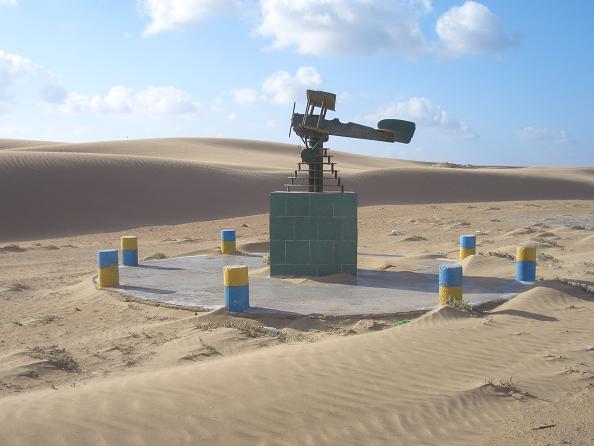
We keep on going south - happy go lucky with the constant hind wind. The coast line is very empty and beautiful. Kind of ideal for a beach holiday if one has a square kilometer of shade and a big fridge in the luggage. We keep waking up early in the mornings to make use of the colder times (BTW in the night we are wearing fleece jackets) and then try to take a rest in some shade during the hottest hours of the day. The thermometer doesn't goes beyond 40 Centigrade but the sunlight is very strong. In the late afternoon we resume cycling until an hour before sunset. We usually pitch up the tent wherever we find a nice spot. We never felt threatened or had any bad experience with wild camping here in Morocco. Very very pleasant.
Sometime somewhere I reach the 20.000km mark... technically I am half around the world already :)


4 May 2010
From Atlas via Anti-Atlas to Western Sahara

It is hard to describe what this great country does to us...
We first cycle from Tangiers south along the Altantic coast and then head inland toward the ancient city of Meknes. We mostly camp wild just wherever we think we should stop for the night; and receive - if any - only pleasant surprises. One night a truck driver stops and comes running over to our tent inquiring if everything is alright, another night the owner of the field of olives trees (Ahmat) in which we pitched up the tent for the night visits us and wants to know if we need bread, milk or water. Later, when a sudden downpour drenches the tent thorroughly, Ahmat shows up again with his son to help us bring the tent and our belongings to his house so we won't have to stay out on our own. We politely decline his offer but wonder how he must have felt later on when the rain turned into a full blown hail storm with hail the size of pop corn (no joke).
From Meknes (very worth a visit) we take public transport to the capital Rabat (with a side trip to Casablanca) to apply for the Mauretanian visa. In earlier times the visa could be obtained directly at the border betzeen Western Sahara and Mauretania. But since a couple of months one needs to pass by the embassy in Rabat. When applying around 0900 hours in the morning one can pick up the visa in the early afternoon of the same day.
With the visa in our pockets we made it back to Meknes and then had a wonderful day riding aith hindwind to Fes. Fes does indeed have a nice casbah, but the city itself is only recommendable for those who love placing themselves in the midst of hordes of caravan campers or enjoy an afternoon full of tout-hassling and being-ripped-off-at-every-corner. The city reeks of what tourism can detroy in a perfectly modest and friendly population.
We just long enough to eat and sleep and leave early the next morning direction Sefrou and the Atlas mountains.


The Atlas treats us with lots of hills, beautiful landscapes, sleepy towns and local food. Susan has discovered a new favorite: greasy bread. It is kind of like filo dough on a cast iron stovetop bathed in butter. Yum.
Another great discovery after a sobering experience in Spain and Portugal (those barbarian tribes have seemingly not yet discovered the secret of fresh milk!) is that Morocco is full to the brim with milk and dairy products. We devour yoghurts and other goodies day in day out. The top product to discover here: avocado milk!
When we don't lay in the shade of some date tree rubbing our dairy filled ballies, we cycle through olive gardens, strawberry fields and orange orchards. The road takes us up up up beyond the tree line all the way to 1907m in the High-Atlas, then back down into the Draa valley and the fringes of the Sahara desert. The temperatures rise every day and soon we decide to get up around 0400 hours very early in the morning so we can be on the road at first daylight to avoid the midday heat. We cycle until around 1100 and then rest in the shade of some roadside trees or - if we hit it lucky - in a small restaurant or truck stop. When the sun starts going down around 1600 we hit the road again and cycle until nightfall.
Against all advise that we had received earlier, the Moroccan traffic is very good to cyclists. It might seem chaotic at first but we soon recognise that most vehile drivers behave with lots of respect and don't force their way. There is a lot of honking but this happens not in order to intimidate (like it would in Germany) but simply to inform about one's presence. Often a couple of quick extra honks are thown in together with a thumbs-up and great smiles. Especially the truck drivers seem to enjoy our presence - thanks be to all of them!
The roads that link bigger cities are often well paved and one needs to go off the beaten track to find a good old counrt road with potholes and a dusty surface. Nevertheless, in the small town of Agdz (towards the Anti-Atlas), Susan's back rim has had it: it breaks. To our misfortune it is friday and many shops close during the prayers. To our greater misfortune the next day is the first of May and a public holiday. The only rim that I can locally find is a very simple Chinese made alloy rim that (my estimation) would last about a week's time. And besides: the spokes in Susan's rear wheel are not long enough to accommodate this rim. While we contemplate over coffee what to do I suddenly spot a fairly nice mountainbike leaning against one of the tables of the nearby restaurant. Am I suffering a heat stroke or is that really a Campagnolo sticker on that rim? I check it out and cannot believe our luck - someone here actually has a real nice rim in hisrear wheel. It's old but it will do the job. Mahammat (the owner of the mountainbike) is located rather quickly once news make it that a foreigner wants to buy his rim. He grins over both ears when we start negotiating the price: approximately 20EUR plus the local Chinese made rim.


Luck in the Unluck (Glueck im Unglueck _ German proverb)! The rim fits with Susan's spokes and Mahammat's spokes are actually sufficiently long for the Chinese model. After about 5 hours of painstakingly sweaty work everything is back together and Susan takes a test ride... hooray!!!
We now cycled several hundreds of kilometers with the new rim and have just reached the Atlantic Ocean again at Tan-Tan. The ocean is wild and beautiful and the absence of European camper vans makes everything even better. Last week we took the bus to Agadir to celebrate Susan's 36th birthday with Pizza and ice cream. Next week we will cross the border to Westarn Sahara and then head down towards Dhakla and then Mauretania. If we are lucky then the current strong wind will be in our back all the way along the coast!
Until later...
(and BTW, that's how our map looks like on a day when we suddenly find a highly loved but totally unexpected dairy product in a small roadside shop :)